Used totes,
perfectly
useful again.
We buy, clean, sell, ship, and recycle intermediate bulk containers. Every reconditioned IBC tote that leaves our yard is one less hunk of plastic and steel destined for landfill.
One form. One person. One day.
Tell us what you need (or what you’re trying to get rid of) and we’ll come back within four working hours from our yard in Green Bay.
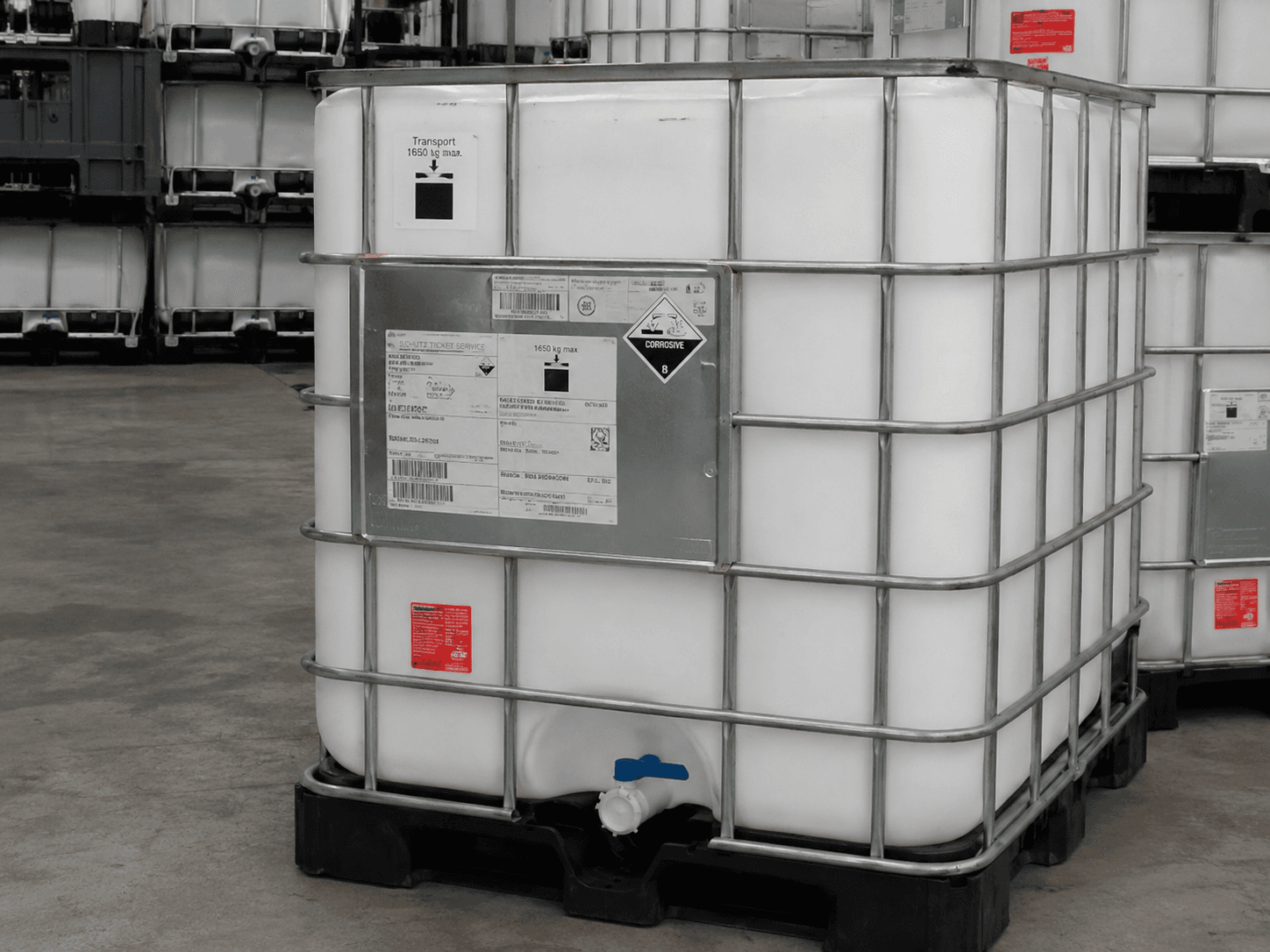
11.2 acres of working space.
Three wash bays, nine trucks, ~5,000 totes on rotation. The yard is open to walk-ins during business hours. Drive in, park near the office. Someone will come find you.
Twelve years of keeping good containers out of landfills.
Five services. One stubborn idea.
The idea: an IBC tote should live three or four lives before anyone melts it down. Here’s how we make that happen.
What happens between “empty” and “ready to ship again”.
Most reconditioners are a black box. We’re the opposite. Every tote moves through six measured stages in our Green Bay yard.
A reconditioned IBC isn’t a downgrade. It’s the more honest choice.
A virgin 275-gallon HDPE tote takes 43 lb of fresh polyethylene, plus another 92 lb of steel for the cage and pallet, plus all the embodied energy of manufacturing, painting, stamping, and shipping it across the country to its first customer.
A reconditioned tote takes ~9 kWh of hot water, a few gaskets, a quart of caustic, and an honest 38 minutes of human attention. Same UN spec. Same volume. Same decade of life ahead of it.
Across our yard, that’s the difference between manufacturing emissions of ~104 lb CO₂e per tote and reconditioning emissions of ~18 lb. The math isn’t close.
Read our sustainability report →Are reconditioned IBC totes safe for food and pharma applications?
Yes, when graded that way. Our food-grade pool is segregated from industrial inventory at intake, washed in a dedicated line, and we keep prior-contents documentation on every tote. We’ll send chain-of-custody with the invoice.
Do you ship outside Wisconsin?
We ship nationwide. Truckload orders go on our own flatbeds. Smaller orders ride with regional LTL partners. We don’t use freight brokers for IBCs — there are too many ways for a tote to get tipped, scuffed, or lost.
I have 12 used totes in a parking lot. Will you really take them?
Yes. We’ll quote pickup and a price for the lot. Even if the totes are too damaged to recondition, we route them to material recovery rather than the landfill. You get a manifest.
Why used IBC totes instead of new?
Cost is roughly half. Carbon footprint is roughly one-fifth. UN/DOT certification is identical. The only real reason to buy new is if your application requires a never-touched bottle — and even then, we sell those too.
How fast can you quote, deliver, or pick up totes?
A quote request reaches a real person in Green Bay and gets a reply within four working hours. In-stock reconditioned orders ship in 24–72 hours, and most empty-tote pickups are scheduled within 2–7 days.
What a typical customer engagement looks like.
- Hour 0
Inquiry
You send a quote request. Form lands in our shared inbox in Green Bay; goes to a real human, not a router.
- < 4 hrs
First reply
We confirm availability, ask the two or three follow-ups we always have (chemistry, location, timing), and quote.
- Day 1–2
PO & scheduling
Once you accept, we lock the slot. Reconditioned in-stock orders schedule for next available outbound; new orders schedule against factory lead time.
- Day 2–4
Wash & QC
Reconditioned totes run through their 14-step cycle. Each one gets a serial-tracked record. Photos on request.
- Day 3–6
Outbound
On a truck. Our driver, our manifest. Tracking shared the morning of dispatch.
- Delivery + 7
Follow-up
We check in once after delivery. Make sure everything is right. Then we leave you alone unless you need us.
Eleven years, four growth phases, one stubborn idea.
“We’ve been buying reconditioned 275-gal totes from IBC Reconditioned since 2017. Zero returns, zero contamination, full chain-of-custody on every invoice. They’ve earned the lock-in.Procurement Director · Regional food ingredient distributor · IL
“They picked up 64 used totes from our parking lot in two days, wrote a check on the dock, and we never saw them piled up against a wall again. That alone is worth the relationship.Plant Manager · Adhesive manufacturer · MN
“The transparency is what sold us. We toured the wash line, watched a tote come through, and signed a standing order on the way back to the car.Operations Lead · Specialty chemical co-packer · WI
“Their food line is the only reconditioner we trust for our edible-oil program. The segregation is real, not theatrical.QA Director · Co-packer · IA
The same totes, twenty different industries.
An IBC tote is one of those quietly universal objects. The same 275-gallon bottle that holds maple syrup on a Wednesday holds adhesive on a Thursday, fermented vinegar on a Friday, and de-icer concentrate the following winter. Here is a sample of who buys from us, in roughly the order of volume.
Chemical distribution
Repeat buys for cleaners, ag chem, lubricants.
Food & beverage co-packers
Syrups, edible oils, brewing adjuncts.
Adhesives & sealants
Industrial PVA, polyurethane, hot-melt feeds.
Agriculture
Liquid fertilizer, livestock supplements, water storage.
Cosmetics & personal care
Ingredient totes, fragrance carriers.
Craft brewing & distilling
Fermenters, water, wash.
Municipal & utilities
De-icer, brine, water station deployments.
Hobby & small farm
Rain barrels, aquaponics, raised beds.
The paperwork behind the practice.
Hazmat liquid IBC certification
Every reconditioned tote retains its original UN packaging mark and is re-leak-tested.
Food-contact compliance
Replacement gaskets used on our food line are NSF-certified for direct food contact.
B-Corp certification (in renewal)
Second triennial verification underway, projected close Q3 2026.
Quality management
Annual surveillance audits clean since 2019. Recertification 2027.
Small-Quantity Generator
Compliant handling of incidental hazardous residues at intake.
Hazmat employee training
All operators current on DOT Hazmat training as of last refresh.
Within our own truck reach, every week.
Our nine-truck fleet runs out of Glory Road on weekly rotations across fourteen states. Outside that radius, we move through three long-relationship freight partners — vetted, audited annually, and the only carriers we trust with a flatbed of IBCs.
| Route | Day | Avg. miles |
|---|---|---|
| WI · MN loop | Mon | 410 |
| IL · IN loop | Tue | 520 |
| MI lower peninsula | Wed | 470 |
| IA · MO loop | Thu | 610 |
| Local WI & UP | Fri | 240 |
| By-request long-haul | Sat | — |
Ready to ship some totes?
Whether you’re buying, selling, or both — the form gets to a human within the next four working hours. Same day during normal hours.